
 1 час назад
4

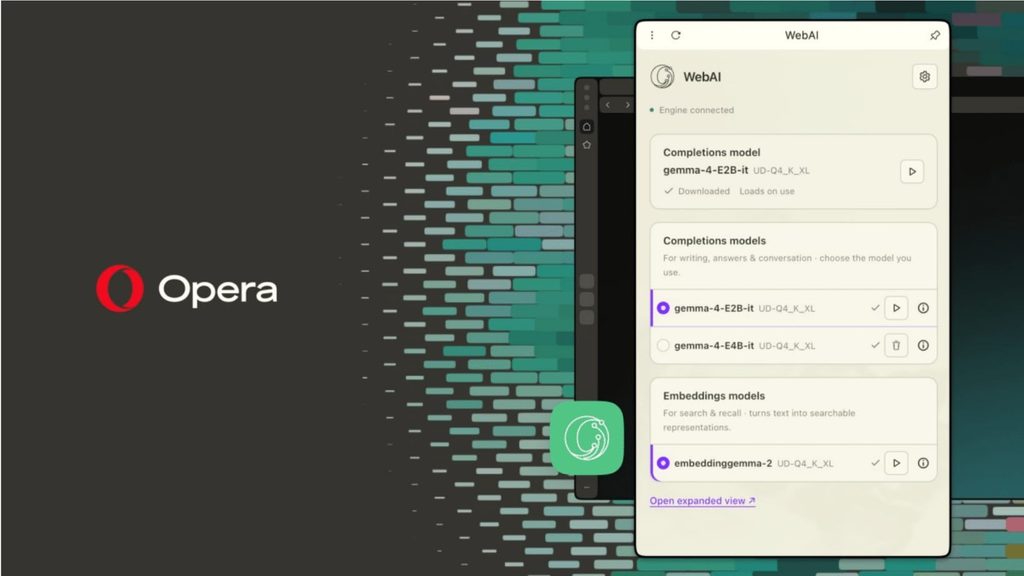
Opera has begun rolling out an early preview of WebAI, allowing websites and browser extensions to use AI models that run on users’ computers.
The new feature launches first in Opera One, with Opera GX and Opera Neon set to follow.
The new feature supports text generation, content classification, and identifying relationships between pieces of information. Opera says developers can use these capabilities without operating their own AI infrastructure or paying a service for each request.
Opera, the Oslo-based browser developer, previously introduced access to local AI models in an experimental developer build in 2024. The latest release extends that work to its everyday browsers, though access remains optional and in early preview.
A new AI processing standard
The company describes WebAI as a proposed web standard supported by companies including Google and Microsoft. Opera’s implementation supports multiple model providers, with initial options including Google’s Gemma models and, on compatible Macs, Apple’s on-device foundation model.
For users, the main privacy benefit is that these local models keep information on their computer, according to Opera. This avoids sending that information to a remote AI service for processing, though it should not be interpreted as a broader guarantee about how a website or extension handles data.
 Opera
WebAI is disabled by default, and Opera says no models are downloaded until users enable it. Separate permissions let users control which websites can access the browser’s local AI capabilities.
Potential applications include extensions that organize tabs, identify clickbait, or highlight relevant job listings. These are examples of what developers could build, rather than a list of features Opera is adding directly to the browser.
To demonstrate the technology, Opera is releasing example extensions, including one that transforms an article into an animated visualization by grouping sentences with similar meanings.
The preview is available on 64-bit Windows computers and Apple silicon Macs. Processing speed depends on the device’s hardware. Opera plans to expand the selection of open models and introduce additional development tools, but has not provided a rollout timetable.
Interactive web pages inside 3D scenes
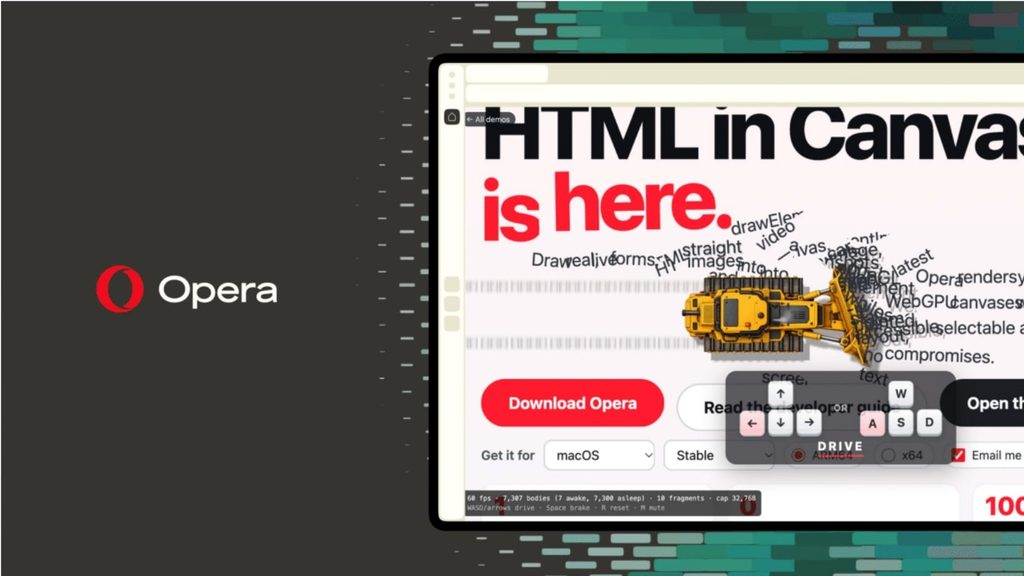
Alongside WebAI, Opera announced HTML-in-Canvas, which lets developers embed interactive web content in 2D and 3D scenes.
 Opera
The feature lets interfaces built with HTML and CSS, including buttons, menus, and forms, stay functional as they move within a scene. Opera positions it as useful for games and other interactive experiences, including those built for Opera GX.
If you liked this article, be sure to follow us on X/Twitter and also LinkedIn for more exclusive content.








 English (US) ·
 Russian (RU) ·